A guide to the Burabi automatic formula maker based on the official instructions: the order for setting the formula number, VOL and temperature, how to use the water tank, and how often to clean the funnel, nozzle, powder container and other parts.
In this article Show
- The Burabi automatic formula maker
- Basic setup takes three steps
- Check the exact product and stage for the concentration number
- VOL 90mL is the water, not the finished formula
- Start at 40°C, and fill the tank with room-temperature water
- Cleaning schedule by part
- Avoid high-heat cleaning and dry fully before reassembling
- The cleaning schedule at a glance, and what to remember
The Burabi automatic formula maker: what confuses first-time users
Once a baby arrives and starts on formula, you have to make a bottle every few hours, day or night. Since checking the water temperature and measuring powder over and over becomes a routine, many households use Burabi (브라비), an automatic formula maker that does this job for you.
When you actually start using it, though, more things are confusing than you might expect. Which parts are the funnel and the powder nozzle, how often each should be washed, how many days between water tank cleanings, what temperature to set, and whether VOL 90mL on the screen really means 90mL of finished formula: there is quite a bit to know.
This post summarizes how to use the Burabi based on the official Burabi website, the manufacturer's guidance, and the formula maker's official preparation instructions. It goes in order, from the basic setup sequence to the formula concentration setting, temperature, volume, and the cleaning schedule and method for each part.
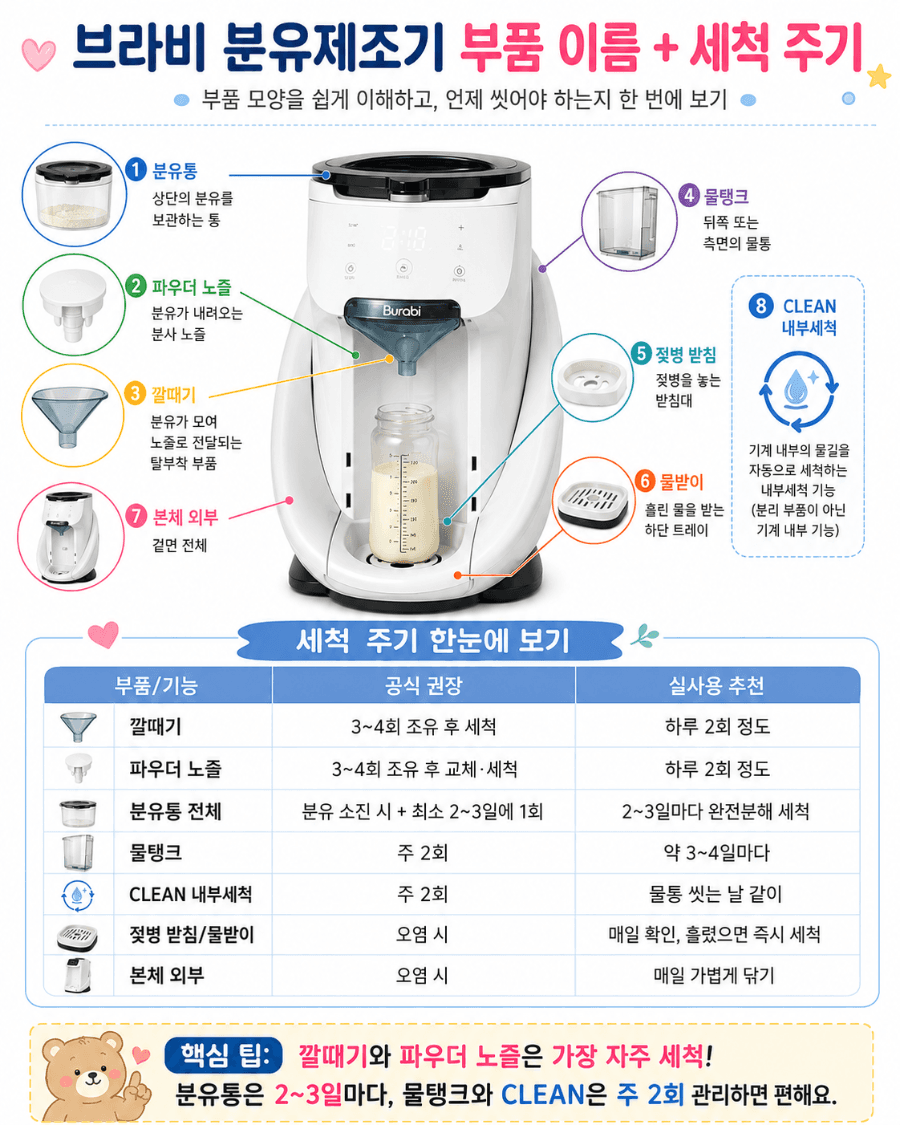
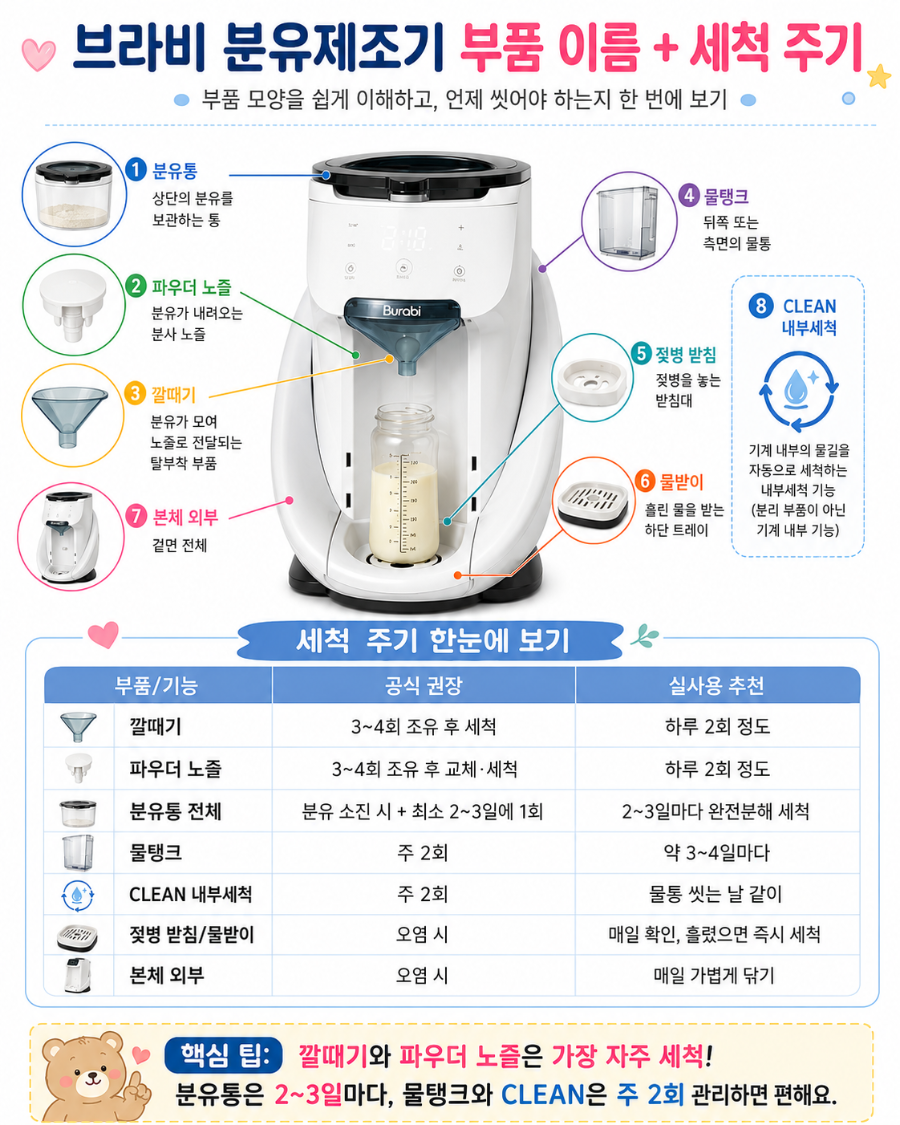
The Burabi is a machine that, once you fill the powder container with formula and the water tank with water, makes a bottle according to the concentration, water volume and temperature you set. The parts that need care are the funnel and powder nozzle that formula passes directly through, the powder container that holds the formula, the water tank, the bottle stand and drip tray where the bottle sits, and the outside of the main unit. Below, I go through setup, use and cleaning one at a time.
Basic setup takes three steps
There are three main things to set before making formula with the Burabi. In order: the formula concentration setting number, the water volume (VOL), and the temperature (TEMP). Remember this order and the process is simple even though there seem to be a lot of buttons. The concentration number is entered once you know which formula you are using; the water volume and temperature come after that.
On the Burabi PLUS, pressing and holding the VOL button for about 5 seconds lets you change the formula concentration setting number. Use the + and - buttons to set the number, then press VOL again to move on to setting the water volume.
Water volume can be adjusted in 10mL steps. Temperature is set with the TEMP button in 1°C steps, and the Burabi's default temperature setting is 40°C. So you can use the default temperature right away without changing it.
Check the exact product and stage for the concentration number
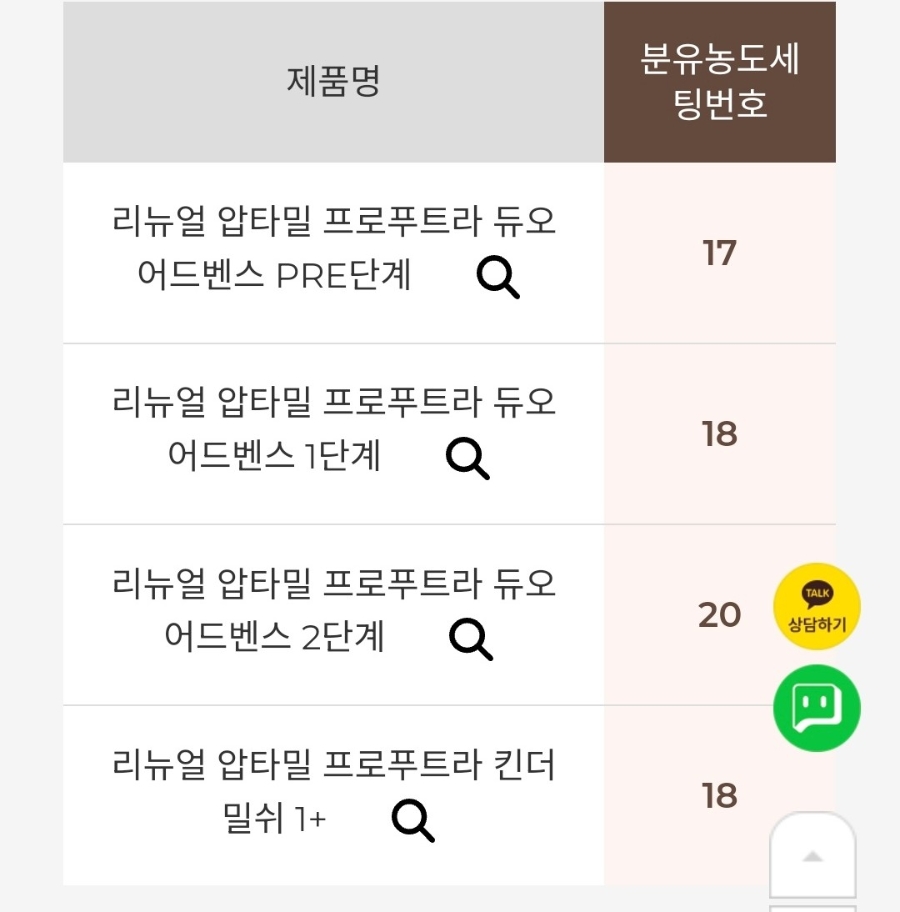
On the Burabi, each formula has a different concentration setting number. That means you should not go by the brand name alone; check the exact product name and stage before entering the number. For example, Aptamil Profutura Duo Advance stage 1 is set to number 18.
Even within the same brand, the concentration number can change with a different product type or stage. So when you move up a stage or switch formulas, it is best to check again rather than keep using the old number.
You can find the number on Burabi's official formula concentration setting number lookup page. Select the formula manufacturer and then the product, and the setting number for that product appears. The concentration setting number determines how much powder is added to the water, so keep in mind that if the number is wrong, the concentration will differ even at the same VOL.
VOL 90mL is the water, not the finished formula
This is one of the most confusing points for first-time Burabi users. The mL shown under VOL on the screen is not the amount of finished formula but the amount of water that goes in.
For example, if you set VOL to 90mL, the set amount of formula powder is added to 90mL of water. So the final amount of formula in the bottle ends up more than 90mL. Put simply, just remember that VOL 90mL means 90mL of water, not 90mL of finished formula.
Because of the added powder, the bottle can end up with roughly 100 to 110mL. When you first start using it, rather than judging the feeding amount by the VOL number alone, it is a good idea to make a bottle and check the markings on the bottle as well. If you treat the VOL number as the finished amount, what you actually made and what you think you made may not match.
Start at 40°C, and fill the tank with room-temperature water
If you are unsure what temperature to set, the simplest answer is to start at 40°C. The Burabi's default temperature is also set to 40°C.
The official preparation instructions for Aptamil Profutura Duo Advance also say to boil clean drinking water, let it cool to about 40°C, and then prepare the formula. They advise dripping a few drops of the finished formula on the inside of your wrist to check that it is at a feeding temperature of about 37°C.
Burabi also explains that once the water at the set temperature mixes with the powder, the temperature can drop by about 2 to 3°C. Putting these together, it is easy to understand that with the Burabi set to 40°C, the finished formula comes out at around 37 to 38°C after the water and powder mix.
Start by setting it to 40°C, then check that the finished formula is warm but not hot. If your baby prefers it slightly cooler, you can adjust to around 38 to 39°C, but unless there is a particular reason, using 40°C as the default is the simplest.
The Burabi is not designed to keep hot water stored in the water tank. Burabi's official guidance says to fill the water tank with room-temperature water of about 15 to 25°C.
If you boil your water, let it cool down fully before pouring it into the tank. The Burabi then heats only as much as it needs to the set temperature when it makes a bottle. So it is best to avoid pouring hot water straight into the tank. Think of it this way: keep the tank water at room temperature and leave the heating to the machine.
Cleaning schedule by part
Cleaning is the part that needs the most attention when using a Burabi. In particular, the funnel and the powder nozzle, which formula passes straight through, need washing more often than you might think.
Wash the funnel after every 3 to 4 bottles. If you make about 7 to 8 bottles a day, it is easy to think of it as washing roughly twice a day.
Replace and wash the powder nozzle after every 3 to 4 bottles. Like the funnel, it is a part formula passes through directly, so manage the two together. If powder sticks or clumps, it can affect how much formula is dispensed, so checking it often is important.
The basic rule for the whole powder container is to wash it once the formula runs out. Even if some formula is left, it is recommended to fully take it apart and wash it at least once every 2 to 3 days. Especially in humid periods such as summer or the rainy season, filling it only about two-thirds full rather than all the way to MAX is also a good approach.
Rather than continually topping up new formula on top of the old, it is better to empty and wash the container on a regular cycle and then refill it. That reduces the chance of old formula staying in the container indefinitely.
Wash the water tank twice a week, which works out to roughly once every 3 to 4 days. The CLEAN internal rinse is also twice a week. CLEAN is not a separate part but a function that cleans the path water travels through inside the machine, so running it on the day you wash the tank makes the schedule easy to remember.
Wipe the bottle stand and drip tray right away if formula or water spills, and even if they are not particularly dirty, it is good to check them about once a day. For the outside of the main unit, a light wipe whenever powder or water gets on it is enough.
Avoid high-heat cleaning and dry fully before reassembling
There are things to watch out for in how you clean, too. Burabi parts are not meant to be boiled like baby bottles. Exposure to high heat can warp them, so it is best to avoid boiling, steam sterilizing, the dishwasher and any other high-temperature cleaning. If you are in the habit of putting other baby items in with the bottles when you sterilize, make sure to keep the Burabi parts out and care for them separately.
Hand-wash removable parts such as the funnel, nozzle, powder container and water tank using a soft brush and detergent. Drying them completely is just as important as washing.
In particular, if you add formula while the powder container or nozzle is still damp, the powder can absorb moisture and clump. Clumped formula affects not only hygiene but also the amount actually dispensed, so reassemble only after the parts are completely dry.
The cleaning schedule at a glance, and what to remember
Here is the cleaning schedule at a glance. Wash the funnel after every 3 to 4 bottles, which is about twice a day if you make 7 to 8 bottles daily. Replace and wash the powder nozzle after every 3 to 4 bottles, together with the funnel. Fully disassemble and wash the whole powder container at least every 2 to 3 days, then dry it completely.
Wash the water tank twice a week, about every 3 to 4 days. Run the CLEAN internal rinse twice a week as well, on the same day you wash the tank. Wash the bottle stand and drip tray immediately when they get dirty and check them daily. Wipe the outside of the main unit lightly whenever it gets dirty.
At first it may feel complicated, with lots of buttons and unfamiliar part names, but there are really only a few things to remember. Set the correct concentration number for your formula, remember that VOL is the amount of water, and start with the temperature at 40°C. For cleaning, do the funnel and powder nozzle every 3 to 4 bottles, the powder container every 2 to 3 days, and the water tank and CLEAN function about twice a week, and always let washed parts dry completely before using them again.
It is a convenient machine that makes formula automatically, but since it makes the formula a baby drinks every day, an accurate concentration setting and regular cleaning are the two things worth never skipping.
This box contains affiliate links. If you book through them, Mudung may earn a commission at no extra cost to you.
 Read nextKeep readingPangyo Lunch: Pork Belly Butadon and Kimchi Cheese KatsunabeRead →